

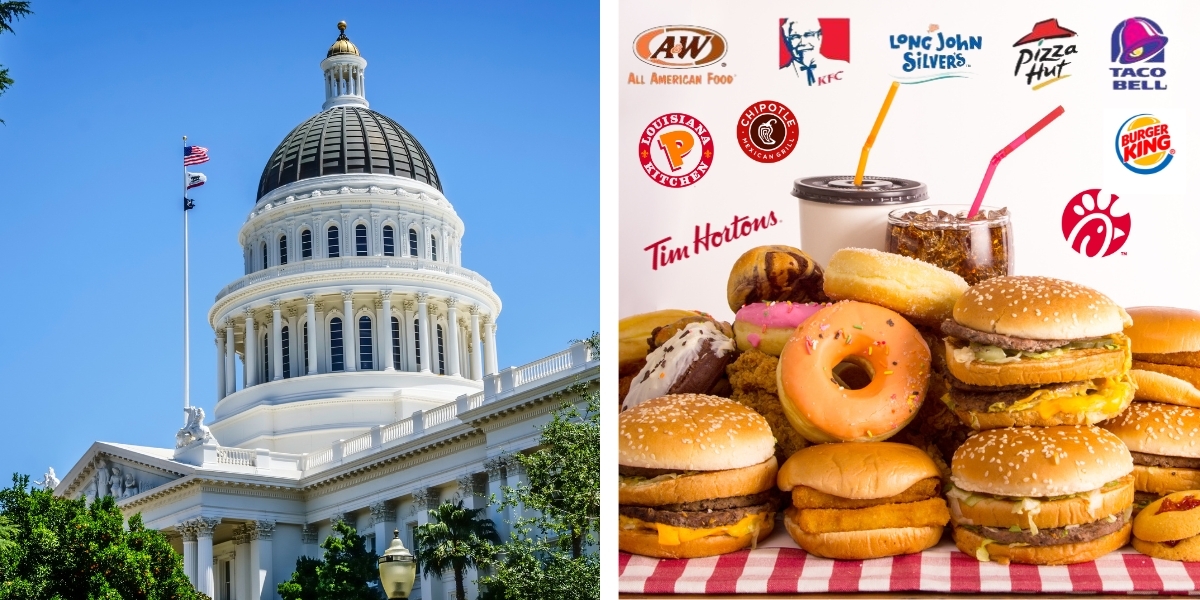
Photo: Canva
CNBC reports that “a fight between fast-food chains and unions in California is over, for now,” and it resulted in the California minimum wage for fast-food workers increasing up to $20 an hour by April 2024. But it doesn’t end there.
A special council of nine members has also been assembled to oversee future minimum wage pay increases in the California fast-food industry from 2025 through 2029. The council will be comprised of four representatives from the fast-food industry, four from the workers’ group, and a neutral chair.
The Fast Food Council lacks the authority to establish working conditions, with its role limited to suggesting standards to state agencies. However, unions will continue advocating for improved conditions. More specifically, the council has “the authority to raise the hourly minimum wage annually by whichever is lower: 3.5% or the annual change in the consumer price index.”
If they hadn’t made this deal, there might have been “a fight between the two sides that threatened to stretch out for years. The restaurant industry was gearing up to spend more than $100 million on the battle.” CNBC also claims that there are industry analysts who agree that higher wages will help avert more costly and problematic consequences.
Before coming to this agreement, Governor Gavin Newsom “signed AB 257, also known as the FAST Act, into law in January. The legislation would have created a 10-person council that would govern fast-food chains with more than 60 locations, including setting guidelines for working conditions and wages. The initial wage hike could have been as high as $22 an hour.”
The fast-food industry, including Chipotle, Chick-fil-A, Yum Brands, and Restaurant Brands International, lobbied against the bill before it even had a chance to reach Newsom’s desk. McDonald’s U.S. President Joe Erlinger publicly criticized the legislation on the company’s website, labeling it “lopsided” and accusing lawmakers of being selective in their targeting.
The restaurant industry pushed for a referendum, letting Californians vote on the FAST Act. However, the Service Employees International Union (SEIU), supporters of the act, claimed the industry had misled signers. The judge disagreed. The SEIU then endorsed AB 1228, a bill holding franchisors accountable for franchisee violations, but critics argued it undermined franchising. While AB 1228 passed the California State Assembly, the Senate didn’t vote on it. Instead, the restaurant sector and unions reached a compromise, altering AB 1228 and agreeing to repeal the FAST Act and withdraw the referendum by Jan. 1.
Currently, experts are weighing in and predicting that the new $20 minimum wage in California will draw more people to apply and work for various fast-food restaurants. This, in turn, might make it more difficult for companies like Amazon, Target, and Walmart to hire their workforce.
Additionally, fast-food businesses must determine how to address increased wages — some might increase prices, risking customer pushback, while others may reduce staff or turn to automation. Despite these concerns, the agreement “provides a more predictable and stable future for restaurants, workers, and consumers,” Sean Kennedy from the National Restaurant Association said in a statement.
The deal sidesteps the feared joint-employer liability changes, preserving the franchise model. While companies like McDonald’s, KFC, and Taco Bell might mostly be unaffected unless they own locations in California, their franchisees will have to address wage increases.
The National Owners Association, representing McDonald’s franchisees, anticipates a $250,000 annual cost per restaurant. Meanwhile, non-franchising companies like Chipotle, with 14% of its locations in California, will directly bear the heightened labor costs.
The new minimum wage bar is being set, and other states, like New York and Minnesota, may also follow suit.
BrainTrust

Neil Saunders
Managing Director, GlobalData

Richard Hernandez
Merchant Director

Janet Dorenkott
President, Jadeco
Discussion Questions
How do you think fast-food restaurants will compensate for this wage increase? Do you think this wage increase will have a negative impact on business owners and their franchises?
Poll
 Loading …
What comes next? Reduced profits. Price increases. Less hiring. More automation. Or some combination of all these things. A wage hike of this magnitude – whether worthy or not – comes with costs and consequences attached.
It does feel like dividing the working market to conquer. Several fast foods in upstate NY are starting $18-20 anyways. But look for many more self-order apps to “skip the line” when they really mean “skip adding employees.”
They will “compensate” by shutting down. This law is a job destroyer and I am somewhat surprised that a bigger fight was not put up by McDonald’s and others. Further, “a special council of nine members” overseeing wages???? Wow, that sentence forces me to reconsider my “job destroyer” statement….this law is a job creator…for government jobs.
California state government is killing the state.
Restaurants will have to compensate for this wage increase with higher food costs, fewer hours, or automation. They have an interest in maintaining or increasing profits so they will have to adjust. Meanwhile, other food places that don’t fit the California legislation definition ( Grocery stores, independent restaurants, dark kitchens, delivery-only restaurants) will gain an advantage versus the restaurant chains that were impacted.
How will they respond? They’ll raise prices if not immediately over the near term.
As to whether or not passing operating costs on to the consumer will cost you business, the answer is an obvious “Yes”. That said, you live in San Francisco on $20 an hour and let me know how that works out. The effective minimum wage in cities like Seattle where the minimum wage is $19 an hour is actually closer to $30 and I expect California will mirror that same pattern and that won’t be good for business or the consumer, but it will provide workers with something approaching – but still not reaching – a livable wage.
The way fast food chains will have to deal with the forced wage increase. Initially, it will be a major hit to the bottom line. Then, some of the following actions will take place.
This is curious – and it will be interesting to see the impact – because, if I am correct, it will set a higher minimum for one particular industry (intuitively, this doesn’t make much sense to me, at least for this particular industry). Owners won’t like it, nor will customers if it simply leads to higher prices; yet what seems to be omitted here is any reference to how employees will react: we often see here on RW comment about how retail underpays, yet every time something is done to change that , it seems there is a lot of negativity.
This is already happening in some states, and the businesses’ answer is to hire fewer people and raise pricing. If this doesn’t work, then close the location. No other way currently to solve this.
In more urban CA areas, already engulfed in layers of taxation, it’s expensive to operate a food business and make money. For sure mandating large wage increases will quickly give a needed boost to workers. And by extension, the businesses respond with healthy increases to retail prices. If customers won’t pay these prices, the businesses close. Will be interesting to watch.
Let’s not forget that pay increases also result in increased payroll taxes, adjustments to payroll systems and other overhead costs. This will force companies to increase prices before pay increases go into place to cover those costs. This act will surely lead to more inflation. My opinion is that supply and demand, based on various markets, along with merit based pay should determine pay. Companies will pay for this mandatory increase with higher costs, lower food quality, fewer employees and more automation.
Franchisors collect royalties as a percentage of gross sales.
This wage increase will translate into a price increase. A big one.
Price increase translates into increased royalties for the franchisors.
Chains like Panera that “sell bread” are not subject to the law.
Who loses? Consumers.
Also expect fewer employment opportunities in this segment going forward. The activists who pushed this hate the sector and want to see it dead, but the reality is this sector employs a lot of people.